Posts

Showing posts with the label Collocations

Using Collocations For Natural English

Image
Intermediate (B1) to Upper-Intermediate(B2) level. Includes CD."Using Collocations for Natural English" helps students improve the way they use the words they already know. Comprising twenty-four units and six review sections, collocations are first presented in simple exercises. Students go on to understand and use the collocations with confidence in a variety of contexts.  "Using Collocations for Natural English" puts an emphasis on learning to use collocations appropriately. Collocations are always presented in typical contexts, and information on formality or informality is included. Exercises include working on a range of text types from tweets to emails, postcards to letters and adverts to newspaper articles. The Links Using Collocations For Natural English - AUDIO.7z 29.4 MB Using Collocations for Natural English.pdf 58.7 MB

Longman Collocations Dictionary Longman Pocket Idioms Dictionary Phrasal Verbs dictionary

Image
The Links Longman Collocations Dictionary_2449.pdf PDF file, 23.5 MB phrasal_verbs_dictionary_longman.pdf PDF file, 26.9 MB Longman Pocket Idioms Dictionary (ESL).pdf PDF file, 30.7 MB

1000 English Collocations in 10 Minutes a Day

Image
This book will teach you typical collocations, organized into 50 topics. There’s no need to spend hours trying to memorize long lists of words and phrases. Each lesson takes just  10 minutes : 5 minutes to  listen  to and  read  the lesson 5 minutes to do the  quiz  and practice the expressions you learned It makes it easy for you to improve your English every day, even if you have little time to study. Just click the green button to pay by credit card, debit card, or PayPal – and you’ll get instant access to download the e-book and audio. The Links 1000_English_Collocations_in_10_minutes_a_day.pdf 1.4 MB 1000-english-collocations_cd_1.7z 113.9 MB 1000-english-collocations_cd_2.7z 109.4 MB

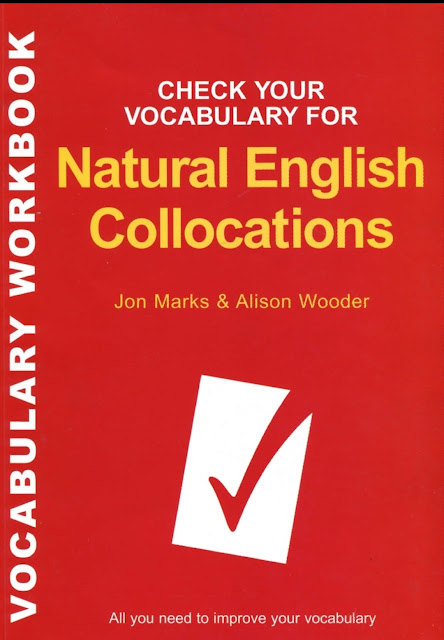
NATURAL ENGLISH COLLOCATIONS

Image
Check Your Vocabulary workbooks are aimed at non-native speakers who want to build essential vocabulary and learn to speak fluent and natural-sounding English.  Containing a range of word games, quizzes and exercises, this workbook will help learners to develop core language skills in a challenging, yet entertaining way. The Link  Check Your Vocabulary for Natural English Collocations PDF file, 38.7 MB

NATURAL ENGLISH COLLOCATIONS

Image
Check Your Vocabulary workbooks are aimed at non-native speakers who want to build essential vocabulary and learn to speak fluent and natural-sounding English.  Containing a range of word games, quizzes and exercises, this workbook will help learners to develop core language skills in a challenging, yet entertaining way. The Link  Check Your Vocabulary for Natural English Collocations PDF file, 38.7 MB

USING COLLOCATIONS FOR NATURAL ENGLISH

Image
Collocations are the key to fluent English. Learning words on their own may enable students to communicate, but to sound natural, students must learn what words typically go together. "Using Collocations for Natural English" helps students improve the way they use the words they already know. Comprising twenty-four units and six review sections, collocations are first presented in simple exercises. Students go on to understand and use the collocations with confidence in a variety of contexts.  "Using Collocations for Natural English" puts an emphasis on learning to use collocations appropriately.  Collocations are always presented in typical contexts, and information on formality or informality is included. Exercises include working on a range of text types from tweets to emails, postcards to letters and adverts to newspaper articles. Examples of conversational English are also included with texts recorded on Audio CD, which allow students to notice feat...

MEDIA COLLOCATIONS

Image
✔ the national/local media  ● The case received enormous publicity in the national media.  ✔ the news media  ● Does the news media have a role in forming public opinion?  ✔ the mass media (=television, newspapers etc, which are seen by many people)  ● The mass media has helped to call attention to environmental issues.  ✔ the mainstream/popular media (=television, newspapers etc, that most people are able to see or read)  ● Few of these events were reported in the mainstream media.  ✔ media attention/coverage/interest etc  ● The tragedy received worldwide media attention.  ✔ a media campaign (=when something is deliberately reported or advertised in the media a lot)  ● A media campaign aimed at reducing drunk driving  ✔ a media blitz (=when something is deliberately reported or advertised in the media a lot, in a small amount of time)  ● The candidate’s media blitz has certainly raised his profile in the election.  ✔ ...

Essential Idioms in English: Phrasal Verbs and Collocations

Image
From catching a cold to landing on your feet, idiomatic expressions add color and style to the English language. The latest edition of Essential Idioms in English remains the resource of choice for mastering more than 500 common English idioms, phrasal verbs, and collocations.  Essential Idioms in English thoroughly defines and illustrates each idiom, then reinforces its meaning and usage with multiple-choice, true-false, fill-in-the-blank, and matching exercises. The Link Click here to download

Essential Idioms in English: Phrasal Verbs and Collocations

Image
From catching a cold to landing on your feet, idiomatic expressions add color and style to the English language. The latest edition of Essential Idioms in English remains the resource of choice for mastering more than 500 common English idioms, phrasal verbs, and collocations.  Essential Idioms in English thoroughly defines and illustrates each idiom, then reinforces its meaning and usage with multiple-choice, true-false, fill-in-the-blank, and matching exercises. The Link Click here to download

Essential Idioms in English: Phrasal Verbs and Collocations

Image
From catching a cold to landing on your feet, idiomatic expressions add color and style to the English language. The latest edition of Essential Idioms in English remains the resource of choice for mastering more than 500 common English idioms, phrasal verbs, and collocations.  Essential Idioms in English thoroughly defines and illustrates each idiom, then reinforces its meaning and usage with multiple-choice, true-false, fill-in-the-blank, and matching exercises. The Link Click here to download

1000 English Collocations in 10 Minutes a Day + Audio

Image
1000 English Collocations in 10 Minutes a Day Click here to get the Links  

1000 English Collocations in 10 Minutes a Day + Audio

Image
1000 English Collocations in 10 Minutes a Day Click here to get the Links  

1000 English Collocations in 10 Minutes a Day + Audio

Image
One of the most common questions that students ask me is: “How can I speak English more like a native speaker?” Marcos from Brazil writes: “I translate in my head from my native language to English… but then my sentences are not correct, or not natural. Can you help me solve this problem?” One thing that can really help you speak English more fluently is learning collocations. Collocations are the typical or common combinations of words we use together. Here are some simple examples: we say "take a picture" and not "do a picture" or "make a picture." We say "a quick shower" and not "a fast shower." When you make mistakes with collocations, the other person will usually understand you – but your English won’t sound “natural” – because it’s different from the way a native speaker would say it. So if you want to improve your fluency and talk more like a native English speaker, you’ll love my e-book, 1000 English Collocations in 10 Minutes ...

1000 English Collocations in 10 Minutes a Day + Audio

Image
One of the most common questions that students ask me is: “How can I speak English more like a native speaker?” Marcos from Brazil writes: “I translate in my head from my native language to English… but then my sentences are not correct, or not natural. Can you help me solve this problem?” One thing that can really help you speak English more fluently is learning collocations. Collocations are the typical or common combinations of words we use together. Here are some simple examples: we say "take a picture" and not "do a picture" or "make a picture." We say "a quick shower" and not "a fast shower." When you make mistakes with collocations, the other person will usually understand you – but your English won’t sound “natural” – because it’s different from the way a native speaker would say it. So if you want to improve your fluency and talk more like a native English speaker, you’ll love my e-book, 1000 English Collocations in 10 Minutes ...

All Clear - 1,2,3 (Listening and Speaking with Collocations)

Image
All clear 1, 2, 3 include dialogues set up the lesson theme and serve as springboards for learning the idioms and other expressions; listening skills are developed through pre-, while-, and post-listening activities related to each units introductory dialogue; "Your Turn" speaking activities encourage learners to use the newly acquired idioms and expressions interactively; numerous listening and speaking activities help build fluency through the integration of reading, writing, and grammar skills; special attention is given to the grammar related to expressions in order to help develop fluency and accuracy. The Links  AC1 Book.pdf 64.6 MB All_Clear_1.rar 138.6 MB AC2_Book.pdf 88.3 MB AC2_CDs.rar 125.1 MB AC3_Book.pdf 88 MB AC3_CDs.rar 154.1 MB

All Clear - 1,2,3 (Listening and Speaking with Collocations)

Image
All clear 1, 2, 3 include dialogues set up the lesson theme and serve as springboards for learning the idioms and other expressions; listening skills are developed through pre-, while-, and post-listening activities related to each units introductory dialogue; "Your Turn" speaking activities encourage learners to use the newly acquired idioms and expressions interactively; numerous listening and speaking activities help build fluency through the integration of reading, writing, and grammar skills; special attention is given to the grammar related to expressions in order to help develop fluency and accuracy. The Links  AC1 Book.pdf 64.6 MB All_Clear_1.rar 138.6 MB AC2_Book.pdf 88.3 MB AC2_CDs.rar 125.1 MB AC3_Book.pdf 88 MB AC3_CDs.rar 154.1 MB

Using Collocations for Natural English

Image
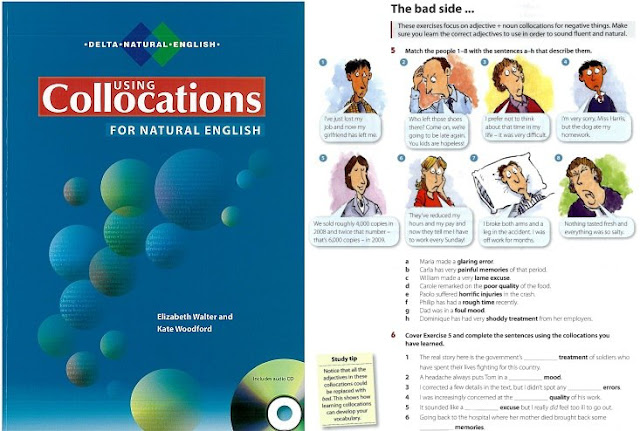
DELTA Natural English is a series of language practice books for students who aspire to use natural, fluent English.   Collocations are the key to fluent English. Learning words on their own may enable students to communicate, but to sound natural, students must learn which words typically go together.     Using Collocations helps students to improve the way they use the words they already know. Common English collocations are first presented simple exercises. Students go on to understand and use the collocations with confidence in a wide variety of contexts.     Key features: Suitable for classroom or self-study use Includes answer key Includes fee audio CD Index for easy reference   The Links Using Collocations for Natural English.pdf 58.7 MB Using Collocations For Natural English - AUDIO.7z 29.4 MB
Using Collocations for Natural English

Image
DELTA Natural English is a series of language practice books for students who aspire to use natural, fluent English.   Collocations are the key to fluent English. Learning words on their own may enable students to communicate, but to sound natural, students must learn which words typically go together.     Using Collocations helps students to improve the way they use the words they already know. Common English collocations are first presented simple exercises. Students go on to understand and use the collocations with confidence in a wide variety of contexts.     Key features: Suitable for classroom or self-study use Includes answer key Includes fee audio CD Index for easy reference   The Links Using Collocations for Natural English.pdf 58.7 MB Using Collocations For Natural English - AUDIO.7z 29.4 MB
OXFORD COLLOCATIONS DICTIONARY

Image
The dictionary that helps students write and speak natural-sounding English. Which words usually go together? This dictionary shows you the common word combinations (collocations) that are essential for natural-sounding British and American English. Completely revised and extended, the new edition has over 250,000 collocations and over 75,000 examples. Click here to download

OXFORD COLLOCATIONS DICTIONARY

Image
The dictionary that helps students write and speak natural-sounding English. Which words usually go together? This dictionary shows you the common word combinations (collocations) that are essential for natural-sounding British and American English. Completely revised and extended, the new edition has over 250,000 collocations and over 75,000 examples. Click here to download